GenAI Literacy: What Is It, and How Should We Teach It? Frameworks, Reviews, Approaches

As the transformative consequences of generative AI, becoming increasingly clear, especially as they pertain to changes in organizations, workplaces, and the education sector educators are called upon to instill a new form of digital literacy: students should be skillfully selecting, adapting, using, understanding, critiquing, shaping, reflecting and questioning generative AI tools and their respective output.
Numerous professional organizations, scholars and practitioners have debated ideas, suggested models, reviewed the landscape of peer-reviewed work, or integrated generative AI into existing conceptual frameworks.
This blog post offers a tour d’horizon of different frameworks, reviews, and definitions.
Frameworks
3wAI
Likening GenAI to a “dragon” whose power must be ethically harnessed by informed “riders”, Bozkurt (2024) introduced the 3wAI framework as a comprehensive model to guide AI literacy development across educational settings by emphasizing three interconnected dimensions: Know What, Know How, and Know Why. The Know What dimension encompasses theoretical and conceptual understanding of AI, including its definition, core technologies, learning processes, model differences, limitations, and capacity to generate synthetic content. Know How refers to practical and operational competencies such as prompt engineering, evaluating AI output, adapting AI tools across contexts, and creating AI-driven solutions for societal benefit. Know Why focuses on the ethical, critical, and philosophical aspects of AI, urging learners to advocate for responsible use, data privacy, transparency, social justice, human oversight, and sustainability.

3wAI Framework, Visualization with napkin.ai. Source: Bozkurt, A. (2024). Why generative AI literacy, why now and why it matters in the educational landscape?: Kings, queens and GenAI dragons. Open Praxis, 16(3), 283-290.
ED-AI Lit
Allen and Kendeou (2024) propose the ED-AI Lit framework to guide the development of AI literacy in education, integrating insights from the learning sciences, cognitive psychology, and artificial intelligence. Aimed at both learners and educators, the framework organizes AI literacy into six interconnected components: (1) Knowledge, emphasizing both foundational AI concepts and the integration of AI understanding across disciplines; (2) Evaluation, focused on students’ critical thinking and source credibility when interpreting AI systems and outputs; (3) Collaboration, which involves interacting productively with AI systems and others, including through dialogic learning; (4) Contextualization, highlighting real-world applications and the transfer of AI knowledge across domains; (5) Autonomy, supporting self-directed, informed engagement with AI tools through problem-solving and decision-making; and (6) Ethics, which underscores fairness, accountability, bias mitigation, and transparency across all aspects of AI education.
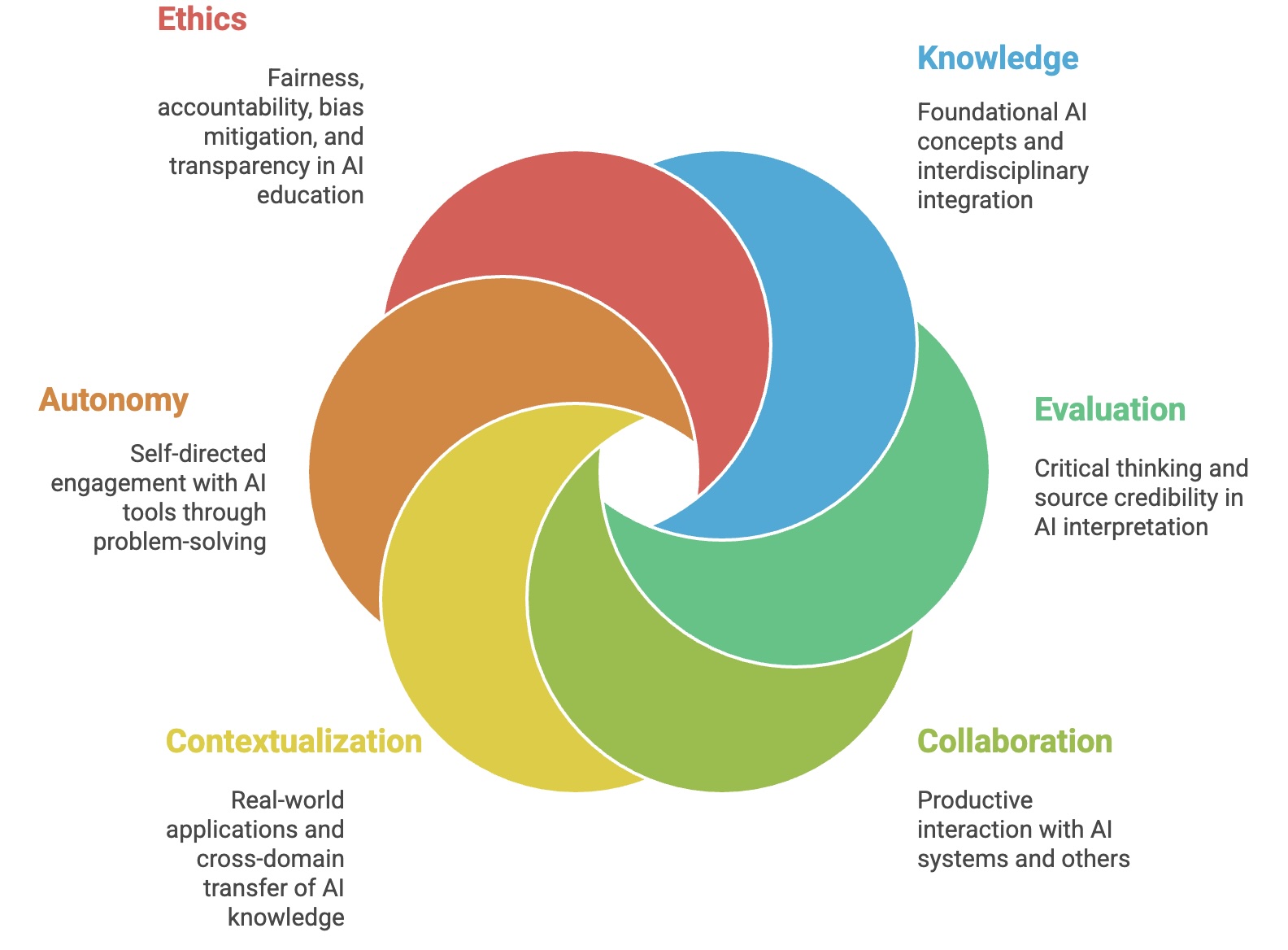
ED-AI Lit Framework, Visualization with napkin.ai. Source: Allen, L. K., & Kendeou, P. (2024). ED-AI Lit: An interdisciplinary framework for AI literacy in education. Policy Insights from the Behavioral and Brain Sciences, 11(1), 3-10.
AI literacy and AI competency
Chiu, Ahmad, Ismailov, and Sanusi (2024) propose a co-designed framework that differentiates between artificial intelligence (AI) literacy and AI competency to support educators, particularly in K–12 contexts. Based on iterative collaboration with 30 experienced AI teachers in Hong Kong, the study defines AI literacy as the ability to explain how AI works, understand its societal implications, use it ethically, and communicate and collaborate with AI systems. AI competency is framed as the confidence and proficiency to apply these abilities in practice, emphasizing critical reflection and self-regulation. The framework comprises five interrelated components—Technology, Impact, Ethics, Collaboration, and Self-Reflection—that guide the development of AI literacy and competency. It emphasizes core technical knowledge (e.g., machine learning, big data, and perception), understanding AI’s societal effects (e.g., future of work, social good, and risk), applying ethical principles (e.g., fairness, transparency, and privacy), fostering collaborative skills (e.g., effective prompting and evaluating predictions), and cultivating reflective habits that support ongoing learning. To operationalize these elements, the authors identify five essential learning experiences: community engagement, case studies, hands-on activities, exhibitions, and culturally responsive learning.
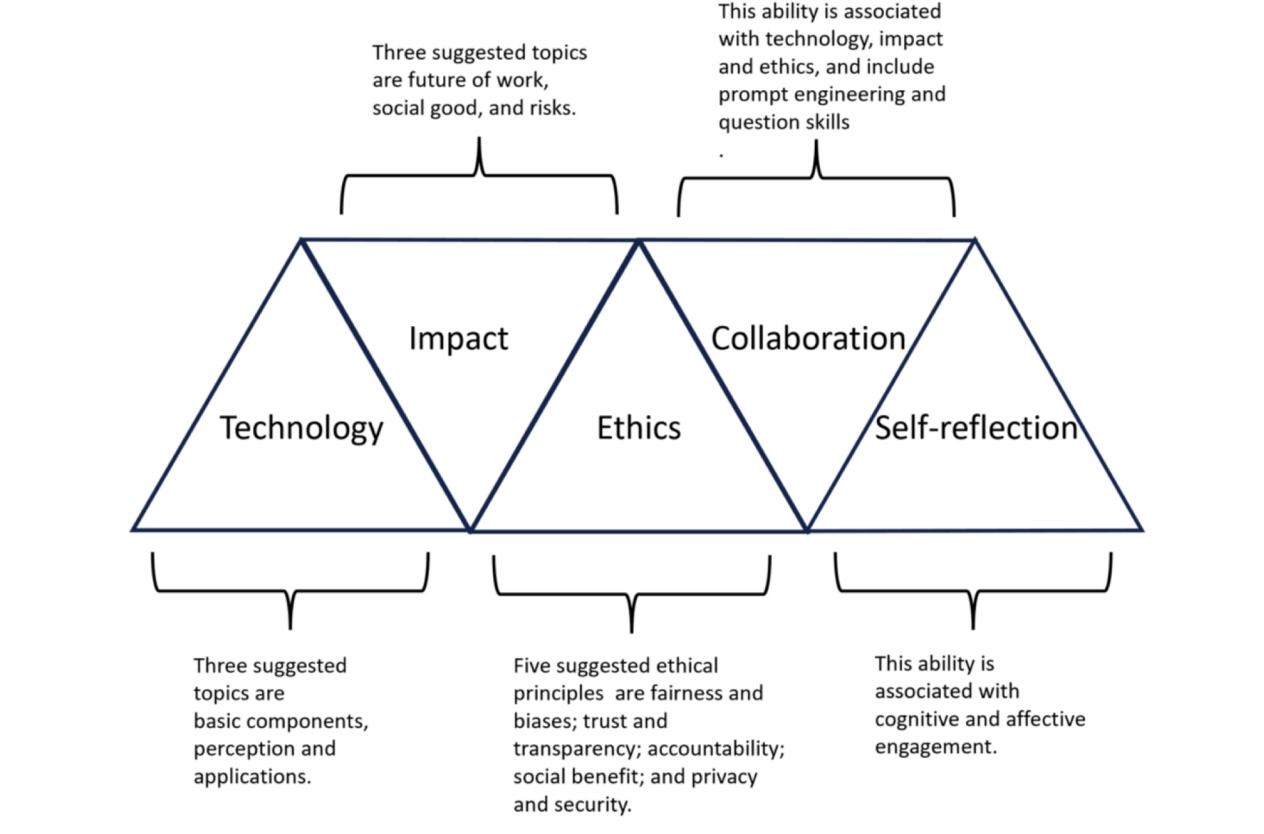
Source: Chiu, T. K., Ahmad, Z., Ismailov, M., & Sanusi, I. T. (2024). What are artificial intelligence literacy and competency? A comprehensive framework to support them. Computers and Education Open, 6, 100171.
UNESCO: AI CFS
UNESCO (2024) introduces the AI Competency Framework for Students (AI CFS), a globally adaptable model outlining twelve AI competency blocks structured across two dimensions: four key aspects of AI literacy and three progressive mastery levels—Understand, Apply, and Create. The four core aspects are (1) a human-centered mindset, emphasizing critical reflection on AI’s societal benefits, risks, and sustainability implications; (2) ethics of AI, addressing students’ capacity to understand and embody responsible, value-driven principles throughout the AI life cycle; (3) AI techniques and applications, focused on conceptual knowledge and practical skills for using AI tools in authentic contexts; and (4) AI system design, encompassing higher-order engineering abilities for problem framing, system architecture, training, and iteration. These aspects are embedded within a competency-based progression model, supporting spiral learning across grade levels and curricular areas. The framework integrates knowledge, skills, and values to foster interdisciplinary, ethically grounded AI literacy and is designed to guide curriculum development, assessment design, and localization based on national AI readiness and educational infrastructure.

Source: UNESCO. (2024). AI competency framework for students (F. Miao, K. Shiohira, & N. Lao, Authors). https://doi.org/10.54675/JKJB9835
OECD AI literacy framework
The OECD (2025) AI Literacy Framework defines AI literacy through four interrelated domains—Engaging with AI, Creating with AI, Managing AI, and Designing AI—each representing distinct ways in which learners interact with AI systems. Engaging with AI centers on recognizing AI’s presence and critically evaluating its outputs, grounded in a technical understanding of how AI works and its limitations. Creating with AI emphasizes collaboration with AI for creative or problem-solving purposes, highlighting ethical issues such as fairness, attribution, and the responsible use of existing content. Managing AI focuses on how learners intentionally delegate tasks to AI systems while preserving human-centered values like empathy, judgment, and purpose alignment, promoting learner agency and thoughtful use. Designing AI enables learners to explore how AI systems are constructed, understand their societal impact, and develop the capacity to shape AI systems for public good. Across all domains, the framework integrates knowledge (e.g., how AI processes data or generates bias), skills (e.g., computational thinking, creativity, and critical analysis), and attitudes (e.g., adaptability, curiosity, and ethical responsibility). Rather than isolating ethics into a separate category, the OECD weaves ethical principles throughout all competencies.
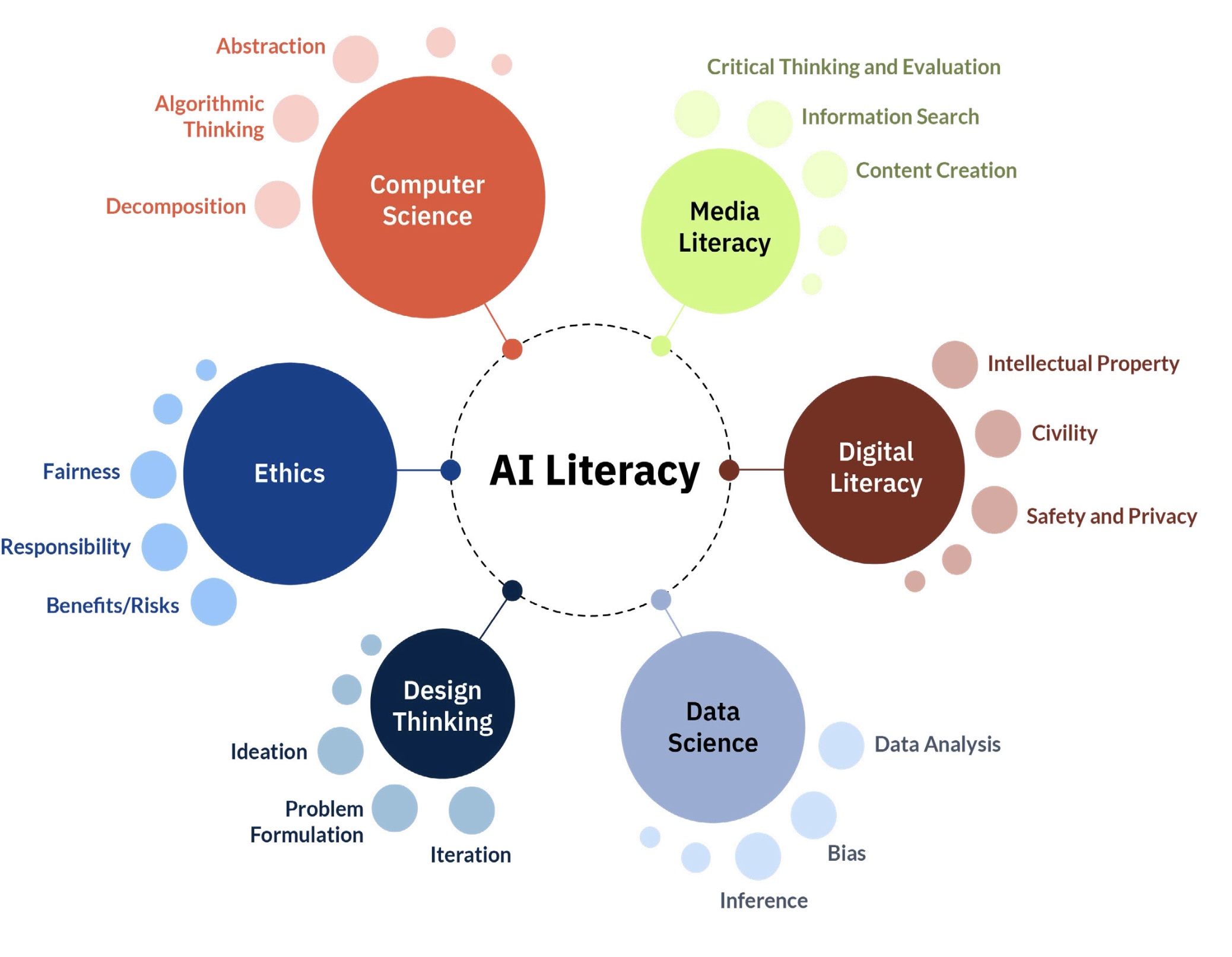
Source: OECD (2025). Empowering learners for the age of AI: An AI literacy framework for primary and secondary education (Review draft). OECD. Paris. https://ailiteracyframework.org
Digital Promise AI Literacy Framework
Digital Promise (2024) presents a multidimensional AI Literacy Framework organized around three interdependent Modes of Engagement—Understand, Evaluate, and Use—to guide educational leaders in fostering responsible and inclusive AI literacy. These modes are supported by six actionable AI Literacy Practices: Algorithmic Thinking, Data Analysis & Inference, Data Privacy & Security, Digital Communication & Expression, Ethics & Impact, and Information & Mis/Disinformation. Together, these practices equip learners to interpret AI outputs critically, examine underlying datasets, assess ethical implications, and responsibly interact with AI tools. Two Core Values—Human Judgment and Centering Justice—anchor the framework, ensuring that decisions about AI use are grounded in ethical reasoning and social equity. AI engagement is further contextualized through three Types of Use: Interact, Create, and Problem Solve, reflecting diverse educational applications of AI technologies. Rather than treating AI literacy as a discrete or technical skillset, the framework explicitly builds on long-standing educational initiatives in media literacy, digital citizenship, data literacy, and computational thinking.

Source: Digital Promise. (2024). AI literacy: A framework to understand, evaluate, and use emerging technology (K. Mills, P. Ruiz, K.-W. Lee, M. Coenraad, J. Fusco, J. Roschelle, & J. Weisgrau, Authors). https://doi.org/10.51388/20.500.12265/218
Digital Promise is a U.S.-based, independent, bipartisan nonprofit organization founded by Congress and launched by the U.S. Department of Education in 2011. It receives public and private funding.
Digital Education Council AI Literacy Framework
The DEC AI Literacy Framework (Digital Education Council, 2025) outlines five interrelated dimensions for AI literacy in both general and domain-specific contexts. It begins with foundational understanding—how AI systems function, how they process and interpret data, and what their outputs imply—emphasizing the need for individuals to critically engage with these tools and make informed choices about their use. The framework also stresses critical thinking, particularly the ability to evaluate AI-generated content, detect bias, verify information, and ensure that human reasoning remains central in decision-making. Ethical and responsible AI use forms a third dimension, focusing on principles such as fairness, transparency, accountability, and privacy, along with navigating risks and regulatory landscapes. The human-centered dimension highlights skills like empathy, adaptability, and communication as necessary for ensuring that AI aligns with social values and supports well-being. Finally, the framework includes a domain-specific component that equips individuals to apply and critique AI within their particular professional or academic fields, addressing contextual challenges and enhancing practice through tailored AI integration.
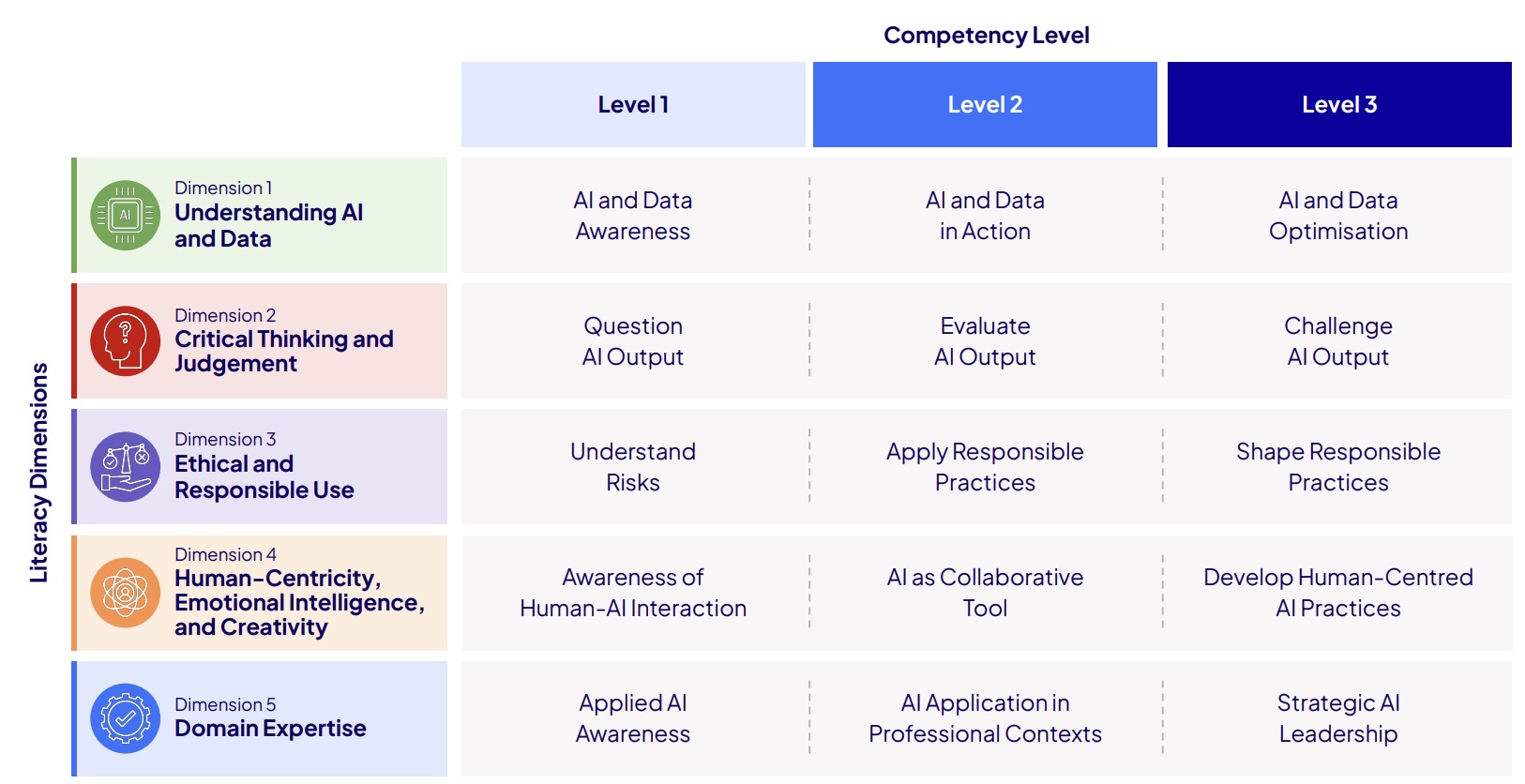
Source: Digital Education Council. (2025a). DEC AI literacy framework (H. Rong, C. Chun, & M. Oliver Roman, Authors). Digital Education Council.
Digital Education Council (DEC) is a membership organization established by the venture capital company SuperChargerVentures together with several international universities in 2024 to address the impact of AI on education.
AI and TPACK
Mishra, Warr, and Islam (2023) use the TPACK framework to examine how generative AI (GenAI) tools like ChatGPT transform teacher knowledge. They argue that GenAI disruptd assumptions across all TPACK domains. Technological Knowledge now involves understanding how GenAI produces novel outputs, including its unpredictability and propensity to “hallucinate.” Pedagogical practices must shift toward critical engagement and reflective assessment, while content knowledge must evolve alongside changing disciplinary and labor landscapes. The authors further argue that teachers must understand GenAI as a “psychological other”—a tool that invites social interaction and anthropomorphization—requiring educators to adopt relational, dialogic approaches to integration.
Source: Mishra, P., Warr, M., & Islam, R. (2023). TPACK in the age of ChatGPT and Generative AI. Journal of Digital Learning in Teacher Education, 39(4), 235-251.
Literature Reviews
Scoping Review: Teacher Education
Sperling, Stenberg, McGrath, Åkerfeldt, Heintz, and Stenliden (2024) conducted a scoping review to explore how “AI literacy” is conceptualized within the context of teacher education. Drawing on 34 peer-reviewed articles dated between 2000 and 2023, the authors mapped AI-related content across the Aristotelian categories of professional knowledge: episteme (theoretical knowledge), techne (practical skills), and phronesis (ethical and professional judgment), further differentiating between explicit and implicit Their review revealed that AI literacy in TE is an emerging but under-defined field, heavily influenced by computer science perspectives and exploratory pedagogical models. Epistemic knowledge often focused on AI concepts like definitions, machine learning, and data literacy, but practical (techne) and ethical (phronesis) dimensions were inconsistently addressed and largely implicit.
Despite the surge in and adoption of ‟AI literacy” in the educational context, also in TE, the concept remains notably underdefined and underexplored in relation to what it means in both educational theory and practice. Our study highlights a prevailing focus on computer science subjects, exploratory teaching approaches, and the incorporation of AI EdTech into classroom teaching. We therefore conclude that the term “AI literacy”, instead of being discussed in depth, appears to serve the specific interests of different professional groups, notably researchers, educators in higher education, and teachers affiliated with the fields of computer science and computer science education.
Source: Sperling, K., Stenberg, C. J., McGrath, C., Åkerfeldt, A., Heintz, F., & Stenliden, L. (2024). In search of artificial intelligence (AI) literacy in teacher education: A scoping review. Computers and Education Open, 6, 100169.
Systematic Review: Definition
Greene and Crompton (2025) conducted a systematic review to synthesize definitions of digital literacy across recent scholarly literature, particularly in light of Web 3.0 developments. They focused on peer-reviewed journal articles published between 2018 and 2023. 285 studies met the inclusion criteria. The authors identified 16 key facets of digital literacy ranging from ICT skills to values, motivation, and socio-emotional capacities. They condensed their findings in a comprehensive definition:
“Digital literacy is guided by the affordances and constraints of context as well as the developmental capacity of the individual, and involves the skills needed to find, access, manage, critique, and integrate information in technology contexts, as well as the ability to build knowledge from that information via metacognition, critical thinking, problem solving, and creativity, all in the service of achieving a variety of desirable life outcomes spanning work, leisure, and civic engagement”.
Source: Greene, J. A., & Crompton, H. (2025). Synthesizing definitions of digital literacy for the Web 3.0. TechTrends, 69(1), 21-37.
Teaching Ideas
Workshop Concept
Sullivan, McAuley, Degiorgio, and McLaughlan (2024) investigated the effectiveness of a brief, 90-minute workshop aimed at improving university students’ generative AI (genAI) literacy. Conducted at Edith Cowan University, the workshop covered topics such as prompt engineering, academic integrity, and ethical AI use. Pre- and post-workshop surveys using Likert-scale and open-ended questions showed significant improvements in students’ confidence, intention to use genAI, and understanding of institutional policy. Participants shifted from vague or general uses of genAI toward specific, academically appropriate applications, such as planning assignments and developing search strategies. However, many students remained uncertain about how to critically evaluate genAI outputs, pointing to the need for continued support and explicit teaching of verification methods. The study also highlighted the challenge of low attendance in extracurricular workshops, underscoring the importance of embedding discipline-specific genAI literacy into curricula. While the short workshop had measurable benefits, the authors argue that sustained, contextualized training is needed to foster deeper critical engagement with genAI tools.
Source: Sullivan, M., McAuley, M., Degiorgio, D., & McLaughlan, P. (2024). Improving students’ generative AI literacy: A single workshop can improve confidence and understanding. Journal of Applied Learning and Teaching, 7(2), 88-97.
Classroom Integration
Pretorius (2023) contends that higher education’s current anxiety over generative artificial intelligence (AI)—often cast as a threat to academic integrity—obscures its instructional promise. Pretorious argues that the central question is not whether students will cheat, but how educators can leverage AI to enrich learning. Through openly “co-teaching” with ChatGPT in demonstration videos, Pretorius models effective prompt design, critical appraisal of AI output, and transparent attribution of the tool’s contributions while mentoring research students to iteratively refine their questions. Such explicit modelling develops AI literacy. The author also highlights persistent challenges, including hallucinations, bias, equitable access, and data-ethics concerns, asserting that confronting these issues through transparent pedagogy will better prepare graduates for a future in which collaborating with AI is commonplace.
Source: Pretorius, L. (2023). Fostering AI literacy: A teaching practice reflection. Journal of Academic Language and Learning, 17(1), T1-T8.
Summary
Taken together, the frameworks reveal clear through-lines: AI literacy is not a single skill but an evolving, multidimensional capacity that blends conceptual understanding, practical dexterity, and ethical discernment. Each concept, mode, definition or framework insists that learners must both wield and critique GenAI to ensure that human judgment, social justice, and well-being remain at the center. The shared underlying assumption is that the “dragon” of GenAI can indeed be safely harnessed, but only if educators intentionally interlace technical skills with critical instrumentation and contextual relevance.
Further Information
This post is the first in a series on pedagogical questions and challenges as well as opportunities and ideas opened up through generative AI. The next one will focus on a workshop example for developing genAI competencies through agile methods in teacher education.
If you are interested in generative AI, review our interview series with AI experts:
- New AACE Open Access Journal ‘AI Enhanced Learning’: A Conversation with Theo Bastiaens and Mike Searson
- AI-Driven Interventions for Teaching Students with Autism – An Interview with Aaron Jones
- Explainable and Trustworthy GenAI: An Interview with Aras Bozkurt
- How AI Works for Education: An Interview with Jon Dron
-
Rick West on Open Education, Equity, and Responsible Use of Generative AI
-
“You have to know about it because your students will be using it.” An Interview with Helen Crompton
-
Generative Artificial Intelligence, Semantic Web and Web Governance: An Interview with Felix Sasaki
-
AI In Education: An Interview with EdTech Pioneer Inge de Waard
-

Gerald Knezek
July 19, 2025 at 10:22 am
Amazing Review! Excellent!
Stefanie Panke
August 10, 2025 at 11:04 am
Thank you!