Why Design Thinking Matters in Teacher Education. An Interview with Logan Arrington

Logan Arrington is an Associate Professor of Instructional Technology and the Interim Department Chair for the Department of Educational Technology and Foundations at the University of West Georgia (UWG). As a comprehensive institution, UWG is dedicated to impacting the state of Georgia and supporting local areas. The College of Education at UWG is the largest in the state in enrollment, producing one in three teachers in Georgia. Arrington is a co-founder of the Southeastern Innovative Teaching Summit, a conference aimed at K-12 educators to share and discuss innovative teaching practices.
Logan Arrington spearheaded a project aimed at integrating design thinking into elementary education funded by the Governor’s Office of Student Achievement in Georgia. This project involved a community partnership grant between the University of West Georgia and two local school districts. Arrington and his colleagues identified the current capabilities and challenges of the participating school districts. They found that technology integration, problem-based learning, and 21st-century skill development were key areas requiring support. Recognizing these needs, Arrington’s team developed a professional development program for elementary school teachers, emphasizing the practical application of design thinking in the classroom. Summer camps facilitated by skilled STEM teachers were an integral part of this project. These camps provided an authentic environment for teachers to observe and practice design thinking with students. This hands-on approach ensured that teachers could see the benefits of design thinking in action, reinforcing their learning and increasing their confidence in implementing these strategies in their classrooms.
Arrington’s work also extended beyond initial training. He ensured sustained support for teachers through ongoing mentoring, grant funds for necessary materials, and direct classroom assistance. His efforts demonstrate that even in rural, resource-limited settings, significant educational innovations can be achieved. In addition to his work on design thinking, Arrington and his team have been involved in various initiatives to promote innovative instructional practices such as development sessions on virtual and augmented reality, showcasing how these technologies can enhance student-centered learning. Arrington’s current projects include collaborations with Apple to explore the educational potential of spatial computing and VR with Vision Pro.
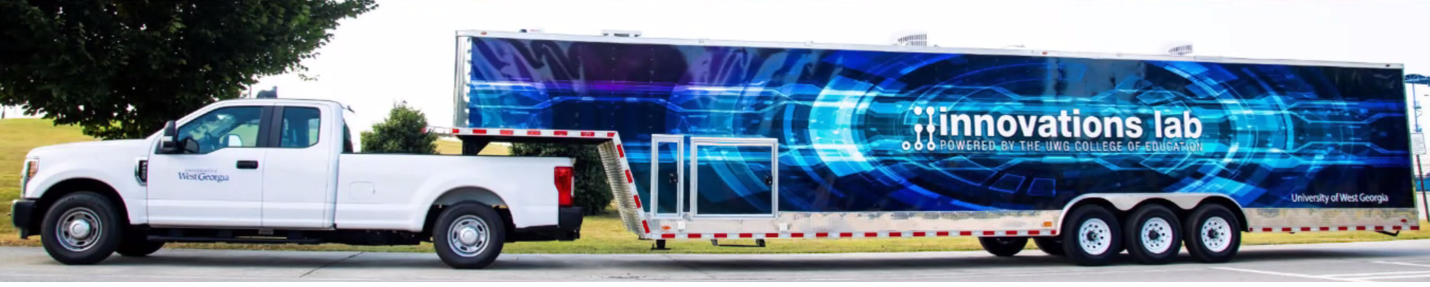
The Mobile Innovations Lab at UWG
A notable aspect of the instructional design team’s work is the University of West Georgia’s Mobile Innovations Lab, a truck and trailer outfitted with design thinking material and educational technology. This mobile lab travels to local schools, bringing design thinking activities and hands-on STEM learning experiences directly to students. The lab includes virtual reality setups, earthquake simulators, and other interactive tools that facilitate immersive, real-world problem-solving scenarios. Arrington and his team of faculty and student volunteers use this mobile lab to conduct programming that often includes design challenges, helping to bridge the gap between theoretical knowledge and practical application.
One theme that runs through all of these activities is the importance of learning from failure, both for students and educators. Failure is a critical component of the learning process. Design thinking inherently embraces this concept by encouraging iterative problem-solving.
In the interview, we talk in more detail about why design thinking plays an increasing role in pre-reservice teacher education and continuous professional development.
What are the challenges k-12 schools face in Georgia?
I don’t know if Georgia is facing any problems different from the overarching K12 landscape. I think most districts are very concerned with staffing. We’re rapidly approaching a teacher shortage and with several educators leaving the profession, districts have to be creative in the ways that they’re attracting and retaining teachers! We at UWG, have actually partnered with a few districts for a program titled Georgia’s BEST (Building Educator Success Together), which focuses on providing teachers with graduate degrees in return for years served in the district. Districts and universities also have to collaborate to ensure that we are generating interest in the career.
In your experience, has design thinking become an integral part of teacher education programs or is it still thought of as an extraneous, nice-to-have activity?
As much as it pains me to say it, I think it is still thought of as a “nice to have” activity overall when considering all teacher education. I will say that a lot of our STEM fields do a great job of utilizing elements of design thinking, but it often stops within the content. We know that design thinking is more about the process and not so much about the product. I think that often our educators outside of STEM fields, and maybe professional fields, do not see design thinking as a strategy they can use for almost any problem, let alone a strategy or approach within the classroom themselves or with learners.
I will say that there are lots of programs that integrate this strategy throughout; however, from my experience, these are usually graduate programs for teachers furthering their education.
How is design thinking implemented in the college of education curriculum at UWG?
One of the most common ways is through the use of the Innovations Lab in the COE. Students often visit and have to think about how they would design lessons around the educational technology within the lab. We utilize this space in both our graduate and undergraduate programs. For example, one of the courses in our department is centered around making, which design thinking is a crucial part of. Within this course, the students visit the lab using telepresence robots (since it is a 100% online program).
There are also lots of co-curricular activities that our students can engage in, including this process. We have hosted STEM competitions, camps, and hackathons through various partners in the university. We also have opportunities for the students to volunteer and work with the Mobile Innovations lab. Our students often can have an opportunity to support these endeavors and see these practices in play.
Do in-service teachers have more excitement or more reservations towards design thinking?
I think it depends, right? Depending on their context, in-service teachers may be more supported to try out new things. I can give an example from our design thinking project. In one district, the schools implemented a more scripted curriculum the year after the professional development. Some teachers saw this as an opportunity to not step outside of their comfort zone, while others attempted several design thinking lessons.
One other anecdote that I have to share is about when students are learning the instructional design process, which we know has a lot of parallels with design thinking for the first time in our graduate courses in my department. The common remark we get from them is – “wow, why didn’t they teach me this when I was becoming a teacher.” I always reply with something along the lines of – well, if I had my way, you’d learn it exactly this way in your first teaching course.
From your experience, what are the positive outcomes of design thinking activities in k-12 education?
First and foremost, design thinking allows students to practice the 21st-century skills that we really want to target, like critical thinking, creativity, collaboration, and so on. Additionally, students are likely to improve their persistence and grit by working through these activities. So, if done well, it can really help students develop these skills. Again, if structured appropriately, it can also support meta-cognition as reflection should be built into the process. It can also help combat the performance orientation that is integrated into our K12 system, since the focus is on the process and not the product. This can hopefully help learners as they move forward.
What are the limitations and potentially unintended negative effects of design thinking activities in k-12 education?
Just like anything, there can always be negatives. One thing that comes to mind is that if not supported right, there can be some uncomfortable emotions within the classroom. I would like to think as students experience and learn through this more, that they’ll get more used to the struggle. One of our teachers talked a lot about the meltdowns that occurred when they were first trying this out; however, they were able to coach the students through it. Additionally, it is not a panacea and should not be used for every single type of activity. These approaches can take a lot of time to plan out accordingly and, depending on materials, could be costly. The final thing is that I think that depending on the topic or the age, the gray area surrounding the ill-structured problems that these tasks often center around can be challenging for both learners and teachers.
The UWG mobile innovation lab is an intriguing innovation. Can you share how this project was first developed, how it was implemented, and how the lab is sustainable?
I cannot take credit for its development. It was born out of our department’s faculty and their want to give back to our local community and the work of the chair of that department at the time, Dr. Lara Willox. Additionally, because we have the stationary Innovations Labs in the College, it made a lot of sense for us to begin thinking about how we can support the P12 learners in the local area. There were lots of other mobile labs that we took inspiration from as well, some supported by universities and others by non-profits. When we originally were conceptualizing the idea, we were looking to purchase and use a school bus, so we called our group “Bus Dreams.” When we realized how hard that was going to be, we pivoted to the truck and trailer.
We offered our first events in Spring 2019. We did a number of free events as we were figuring out everything, which ranged from elementary school to high school. Additionally, we did a lot of work in the summer with the public libraries. Obviously, COVID shut us down when it hit. After it was safe to start back up, we immediately got back out there. We have gone through several iterations of the type of programming we offer. We started with more of a showcase-and-play approach. We would have several things out and available for students and let them explore and experience. Now, we’ve moved into a much more structured approach. We utilize virtual reality for half of the time students visit the lab, taking them places as a group that they cannot usually go to. Then, we follow up with a brief design activity that typically is built around engineering or coding/robotics. All of these activities are led by our faculty or advanced students at UWG.
Sustainability is a bit of a challenge truthfully. We do charge a small amount of money to do events with our partners; however, this is really just to cover the cost of the lab, materials, and maintenance. Additionally, we’ve been fortunate to receive grants and gifts to support our lab. This allows us to offset costs a good bit. We’re very fortunate that we’ve built this in such a way that when our faculty volunteer their time, they are able to use it for their service category within their annual reports.
How can teachers learn from failure and not only teach but also develop resilience?
Encountering failure seems to be much harder on teachers than it is on students, more often than not. There are definitely challenges there. In some of the work I have done, I have had school leaders say, “We don’t even use the word failure in our school,” which I think is really interesting. I think we often wince when we hear the word, too. One of my colleagues dubbed it the pedagogical “F” word, which I actually think is pretty true.
For teachers, I think the key is reflection or reflective practice. It also helps if we’re approaching everything from a day-to-day and with a mastery-oriented mindset. I know it is hard to do that when it is work, but it still can be used. Teachers need to be able to reflect on the experience and diagnose the areas where things went awry. They can exercise their systems thinking to also help themselves not feel the brunt of the fault. When things go sideways, teachers need to reflect on it and improve the things that can be improved. Sometimes, those things are our own practices or beliefs based on the situation.
I think another part of it is that often a failure experience is related to a loss of control in a variety of ways. And we both know that just because things are out of control, it doesn’t mean learning isn’t still happening within the environment.
Anything else you would like to share?
Thank you for this opportunity. It was great to share about the things that our folks are doing!
About
 Logan Arrington is an Associate Professor and Interim Chair in the Department of Educational Technology and Foundations. His focus area is in the Instructional Technology program, where he teaches graduate level courses on Instructional Design and Human Performance Improvement. Logan’s research interests are failure-based instructional strategies, professional issues in the field of Instructional Design and Technology, and authentic learning opportunities for underrepresented groups. Logan is an active member in both the American Educational Research Association and the Association for Educational Communications and Technology.

Iolanda Cortelazzo
July 19, 2024 at 11:17 am
I really liked it a lot. I am a 76 year-old retired teacher and preparing a program in my website for teacher development and will translate part of this interview to post to teachers of Basic Education (K-to12 and high schoo) in Brasil.
Many private schools have already been working with design thinking, but public schools haven’t. The idea of the Mobile Innovation Lab is geat.
Some State Departments of Education had this kind of Lab in the nineties to present local public schools the computer lab, but that’s all.
Most of teachers in fact are resistant to technology and just use digital technology to reproduce traditional one way communication.
Thanks for this article!