“Thinking Always Trumps Prompting”: An Interview with Inge de Waard
Inge de Waard works at the intersection of instructional design, innovation, sustainability, and artificial intelligence. Based in Belgium, she is the AI strategy and learning coordinator at InnoEnergy, where she supports teaching and learning in the field of renewable energy while exploring how emerging AI tools can be used thoughtfully in educational design. With a background in education and a strong interest in experimentation, collaboration, and applied innovation, she brings a distinctive perspective to the evolving role of the instructional designer.
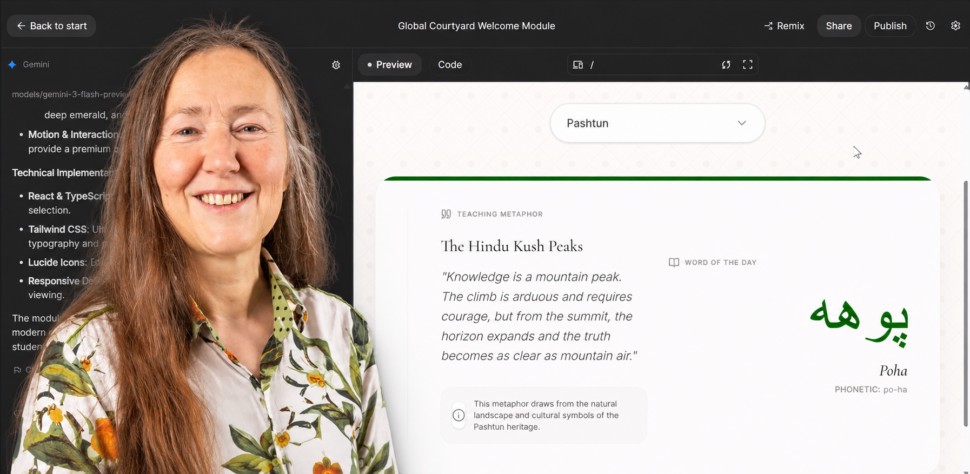
Inge is interested in what AI can make possible for educators, from prompting and differentiated learning design to AI agents, agentic workflows, and vibe coding. At the same time, she emphasizes that good educational design depends on context, judgment, and human expertise. I had a chance to catch up with Inge’s work at a guest lecture this spring at the Asian University for Women. During her talk, she gave a live demonstration of vibe coding in form of a language and culture app built in Google AI Studio. Just one of the many ways in which Inge leverages AI for creative expression. Inge is an explorer of the digital frontier, with a firmly human-centered mindset: ‘Thinking always trumps prompting’, she emphasized.
Interview
In this interview, we speak about the future of instructional design, the promises and limits of generative AI, and why, as Inge puts it, “thinking always trumps prompting”.
You have described your work as sitting at the intersection of instructional design, innovation, sustainability, and AI. How did those strands come together in your career, and how do they shape your work today?
When I was retraining myself later in life using a vocational training opportunity at the time, eLearning was up and coming, so I prepared to jump into an elearning design position. But once I got into that, my interest in combining education with technology emerged and it never went away. No matter which new technology coming up offering new learning options, I jump on it. This has pushed me to explore innovative ways of using such technologies or even work collaboratively to get a new innovation going. While the sustainable aspect comes from my lifelong interest in ethics and philosophy (initiated and nurtured by my mom who is an avid philosophy learner). These combinations make up for a satisfying professional interest.
Your title and responsibilities place you in a space where pedagogy and emerging technology meet. How do you currently see the role of the instructional designer changing in response to generative AI?
Any role that sits on the brink of providing a service that is enabled by a computer, is now in a transformative state. For instructional designers two different speeds emerge. On the one hand you have the Generative AI (GenAI) models becoming much more adept at building courses (thus saving time, which means less work to be divided across time), and on the other hand you see more sloppy constructed online learning appear, as some people think GenAI can build any course they need. So, to me, I feel that strong instructional designers are definitely needed. But this means that building up the expertise and the evidence-based know how on how to optimally build courses is crucial. We are living in an era where those looking at budgets feel that budget trumps all, where I would say that human capital is in fact the distinguishing factor to build quality courses. In too many cases a new company chooses to work with an innovative authoring tool that promotes itself as sublime, but actually only delivers weak course interactions or even course overviews. A strong instructional designer can distinguish between strong learning content and weak un-validated AI results. So, we need to become stronger as a professional group. I think it is crucial to really dig into pedagogical theory, and turn that theory into practice whenever you can. Staying critical, looking at what adds to quality, and building your own insights to become an instructional designer that can showcase and proof what good (online) learning looks like.
You are concerned about the risk that people may use AI in ways that weaken, rather than strengthen, their own developing expertise. What does it look like to use AI in a way that actually helps someone become a better instructional designer?
The key – for me – is to practice critical self-reflection, where we realize whenever we have a lazy day or a deadline is so ridiculously sharp that we must use AI to come up with results. And than be firm: AI is good, but not the overall answer to all specific needs that a course has. Using AI to draft some bits of a course can be helpful, as long as we review it (= we get the time to properly review it), and we keep up to date with the latest pedagogical research on what works and what does not. Even if we embed these new insights into an instructional design agent that builds courses, we still need to go over it as a human. A rule of thumb I use is: write an overview of what you want yourself, make sure to go into some detail, make a clear picture of what you want in your minds eye, only then go to AI for the first time. And once you use it, disagree with it whenever you feel something is not right. By disagreeing, you sharpen your critical mind. That in itself is useful no matter where you work or what you do.
How have prompting skills changed over time, and what do you think distinguishes a strong prompt today from what would have counted as a strong prompt even a year or two ago?
In the beginning prompting had a specific structure that you could use for anything a person was looking for. By now, we know that there are multiple prompting techniques we need to apply in order to get a strong answer. So prompting is no longer one size fits all, it is depending on the needs of the prompter. In addition, we can now go to GenAI to write a prompt for us based on our natural language, where in the past you needed to use specific prompting jargon to tweak possible results. It still amazes me how quickly prompting still changes, what works now, will probably get redundant in another 3 months’ time.
How would you explain the difference between a prompt, an agent, and an agentic workflow?
My go to definition is based on my use, so informal, but it works. Although I must say that the distinction between a long prompt and an agent is slightly becoming foggy. But in essence, a prompt is mostly a clear instruction to get a specific result (e.g. summarize this document, or what is the weather like in Kazakhstan during June). An agent might work on instruction, but will also get more context, or data, or documents that help it create a more textured background before coming up with a result (e.g. a course design assistant that knows what I like to see as an instructional designer, and follows those guidelines to build a course). An agentic workflow is a full process that (might) link several agents that have specific instructions or goals, and comes up with a result after a set of searches, analysis, validations and alike set out by each part of the workflow (e.g. review a course, identify gaps, check sources, suggest improvements, rewrite certain paragraphs or formatting).
Many educators are asking not whether they should use AI, but how much reliance on AI is too much. How do you think about the line between meaningful support and overdependence?
This is really tricky, but to me it all depends on self-reflection. If I detect that I had a lazy day, that I let AI do all my thinking and I hardly reviewed a passage or a result… than I am at risk of becoming an automaton, or simply dumbing down. AI should be a tool, where all of us should still be training our brain to grow and become better. What I do is, I remind myself that AI only works on patterns, this means I can come up with something that is seldom used or even never used before. We can look into the future and build it, where AI cannot see into the future, but only back based on what it is trained. Overreliance is no longer coming up with your ideas on a daily basis.
AI often reproduces dominant patterns rather than local, cultural, or discipline-specific nuance. How do instructional designers resist this flattening effect and design for real learners?
Be completely conscious of this. Ask from the start to integrate nuance, cultural or local customs etcetera in the answer (and based on my experience, not only at the start but again and again, every so often). GenAI is not based on our local cultures, but on the dominant culture (more patterns come from that as a result). But we can tweak it, and although this does take more time, we owe it to our culture to emphasize its importance to GenAI.
You have emphasized the importance of experimenting with AI to stay current. What are some approachable ways for educators to get started with advanced AI-features such as vibe-coding?
Start with something you always wanted to do, but could not manage due to restraints. And start from there. You will be much more motivated to pass through any hurdles that you might come across, and it will lead you closer to this idea or innovation you had in mind. For instance, if you always wanted to be an astronaut, build a dashboard that will allow you to train to become one, or make a tool that will teach you all about being an astronaut. Similar if you want to write the story of your family in a book. Build a vibe-coded tool that will allow you to go through the process of writing a family chronic one step at the time: building the persona’s, tweaking the stories so that they become page turners, embed drawings or pictures… It is all about starting from a highly motivational idea and moving forward with that. And it is fun!
During your guest lecture at the Asian University for Women you blew away the audience with a hands-on demonstration of a Global Courtyard app that you vibe-coded within minutes. How can AI specifically support multi-language and multicultural classroom settings?
I see vibe-coded dashboards or tools as an easy add on to our own class needs. Up until now, we had to rely on whatever companies came up with in terms of educational tools or books. Now, we can write our own, make it meaningful to our learners and offer more diversity even in a very local region. To me, this makes AI very useful (but still limited due to not always knowing all the intricacies of local language or customs).
Community plays an important role in your approach to AI. How do professional networks, shared experimentation, and peer exchange help you stay current and think more critically about new tools?
Without my peers I would not be able to stay on top of AI. Some people in my network do just that: curating GenAI information, so it is becomes easier to digest and pick up. I need their curation, as I would have no time left for my regular work if I needed to stay on top of everything myself. Of course, I also select what is useful to me or not, but even reading the headlines of those articles tend to give me some idea of how the current GenAI landscape is transforming.
When educators and students experiment with AI tools, a concern that frequently arises is privacy. What danger can stem from AI in terms of the information it knows about us? What is a good rule of thumb to stay privacy-cautious?
If you would not put it on a public website, don’t paste it into a free GenAI tool. And remember, whatever you share on a free GenAI tool, will be shared as training data. So do not put your latest invention on it, do not put any names or harmful information on it (health issues, etc). And if you can make use of a private, paid GenAI version, make sure you check all the necessary settings that relate to privacy.
What advice would you give educators and students who want to experiment with AI creatively while still protecting their work, their voice, and their integrity?
Use AI to expand your thinking, not to quietly replace it. Enter into a conversation with it, but disagree from time to time to test how it works. Keep in mind that it is a machine, even though it uses very familiar human language. And do not disclose personal information, for you never know what happens to that information (whether it is stored, used, sold to third parties…). GenAI is offered by big companies that can change how it acts at any time, this means you are not in control of how it works behind the screens. This means you need to stay alert and vigilant, while still experimenting with it and enjoying it for what it can do. Have fun, stay critical!
About
 I am a longtime researcher, activist, and award-winning learning innovator. I currently work as a passionate AI strategy &learning coordinator for the Masters+ at InnoEnergy (European network of engineering and business universities). In the past, Inge coordinated multiple online & hybrid initiatives, co-designed AI tools and EdTech. I co-create international, blended curricula with engineers and teachers, while exploring and embedding active learning formats. Papers, invited talks & keynotes.
