Pressing Prompts: An OER for AI in Higher Education
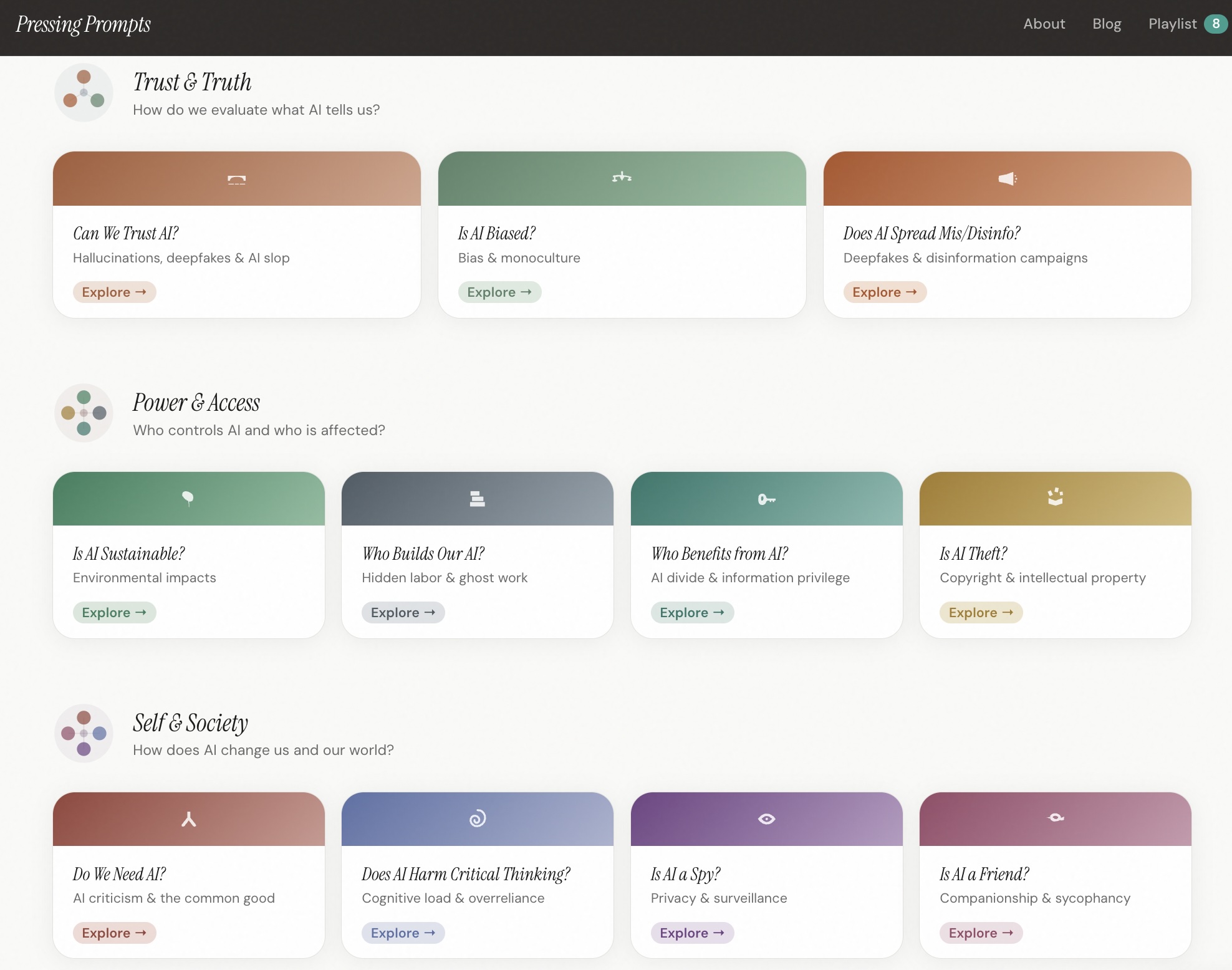
Pressing Prompts is an open collection of teaching activities and resources designed to help higher education instructors engage students in discussions about the social and ethical implications of artificial intelligence. The project originated at Duke University through a collaboration among undergraduate students, librarians, faculty, and learning technologists. Its primary audience is college and university instructors across disciplines. Librarians, instructional designers, and faculty developers may also find the materials useful when planning courses or workshops on AI literacy and ethics.
The site organizes its content around 11 questions, including “Can We Trust AI?,” “Who Builds Our AI?,” “Is AI Sustainable?,” “Does AI Harm Critical Thinking?,” and “Do We Need AI?” These questions are grouped into three broader themes: Trust and Truth, Power and Access, and Self and Society. Each topic page includes a short introduction, key terms, learning objectives, conversation starters, structured activities, disciplinary extensions, and recommended resources. Many activities provide versions for both face-to-face and online teaching, and several include options that do not require students to use an AI tool. “Learning Notes” offer additional guidance for instructors, such as preparation advice, grading criteria, suggestions for large or online classes, content warnings, and possible modifications.
The Pressing Prompts development team is open about its use of AI, specifically Claude Code/Opus 4.7. AI assisted in content architecture, technical production, web interface, illustrations, icons, typography, and digital accessibility review. Notably, the entire “Do We Need AI?” topic is deliberately designed without AI.
Instructors can browse the materials by topic or open collections of conversation starters, student-centered activities, and disciplinary extensions. Individual items can be added to a playlist and then expanded, removed, printed, saved as a PDF, or downloaded as a Markdown file. No account is required. Playlists remain in the working memory of the current browser tab and disappear when the user closes the tab or navigates away, so instructors need to export their selections before leaving the site.
The playlist allows instructors to collect conversation starters, structured activities, and disciplinary extensions from across the site. Selected items can be expanded, removed, printed, saved as a PDF, or downloaded as a Markdown file. This provides a convenient way to review and organize materials from several topic pages. Upon testing, the PDF export and print option worked only for some, not all playlist items.The usefulness of the Markdown export is limited for instructors who want to transfer the materials into a learning management system. Most learning management systems do not import Markdown files as structured course content. Canvas, for example, requires IMS Common Cartridge. To test the export more fully, I converted a Pressing Prompts Markdown playlist into an IMS Common Cartridge and imported it into Canvas. This did not produce a ready-to-use learning module. Much of the imported content directed the instructor back to the Pressing Prompts website instead of functioning as self-contained LMS content. The best process for instructors is to copy material into individual pages, discussions, assignments or handouts. ,
Pressing Prompts is grounded in critical pedagogy. Many activities ask students to develop definitions, identify patterns, produce maps or analyses, compare lived experiences, and build conclusions collectively. These learning activities resist the “banking” model in which an instructor delivers the correct position. Activities such as disconnecting from AI, mapping its labor supply chain, reviewing privacy policies, analyzing personal AI privilege, and examining the consequences of algorithmic representation direct attention toward labor, ownership, surveillance, compensation, access, and institutional power.
Most sources referenced in activities are news coverage and opinion pieces. While the reliance on journalism has advantages for rapidly evolving topics, at times, the source selection appears eclectic. As an example, the collection includes Mike Caulfield’s 2025 Atlantic article, “AI Is Not Your Friend,” but his major contribution to misinformation education is absent from “Does AI Spread Mis/Disinfo?”. On occasion, resources required to carry out the activities are omitted from the description. For example, the environmental impacts activity instructs students to read an assigned article and asks the instructor to divide the class into groups, with each group reading a different article. The activity does not identify or link the articles. A second activity asks students to use resources “discussed in class and shared in this topic”. An instructor must return to the topic page, locate appropriate resources, determine which ones, if any, correspond to the activity, and add them to the course. More substantive information, in addition to questions and discussion prompts, would increase the ease of reuse.
As an Open Educational Resource (Creative Commons Attribution-NonCommercial-ShareAlike 4.0), Pressing Prompts can be extended, translated, and enhanced. Individual instructors, departments and organizations can adapt and improve the material. Pressing Prompts has the potential to serve as a foundation for locally developed versions that add disciplinary perspectives, update or supplement sources, respond to new developments, and address the needs of particular students and institutions.
