Psychboard: An Interview with Alyssa Draffin
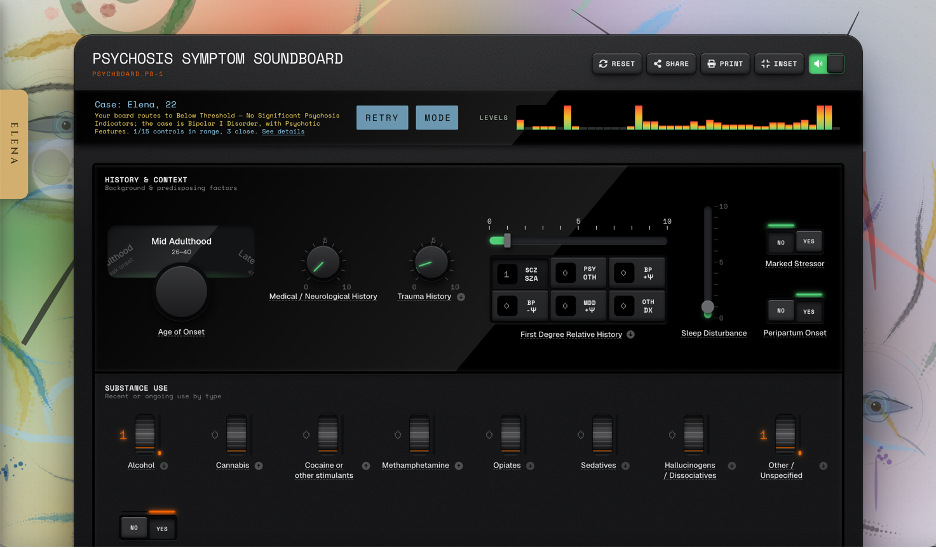
Psychboard is a free, browser-based learning resource that invites students to explore psychosis assessment through an interactive “soundboard” of symptoms, contextual factors, and clinical characteristics. Rather than treating symptoms as simply present or absent, learners adjust dials and controls to represent their severity and interaction within a case, then compare their assessment with ranges established by expert reviewers. Developed by Alyssa Draffin, Clinical Assistant Professor at the UNC-Chapel Hill School of Social Work, Psychboard combines clinical cases, dimensional assessment, explanatory resources and an immersive visual design to create an engaging environment for practicing holistic clinical reasoning. In this interview, Professor Draffin discusses the inspiration behind Psychboard, its development, and the opportunities and challenges she sees for digital innovation and generative AI in social work education.
Interview
How did you come up with the idea for Psychboard? The site credits an episode of the podcast Back from the Abyss as an inspiration. What was the connection between the podcast and the soundboard concept?
When listening to the podcast episode, the host and psychiatrist, Craig Heacock, described the mind as a soundboard. Something clicked in my understanding of how all of the symptoms of psychosis come together to create a whole picture, and there is such a variety of how symptoms present.
What learning problem were you hoping to address? Were there particular difficulties you observed when students learned to assess psychosis or distinguish among related diagnoses?
What I noticed, both in myself as a student and later in students I was teaching, was an over-reliance on positive symptoms like hallucinations and delusions when assessing psychosis. Those are the most recognizable features, so they’re where attention naturally goes. But that focus can crowd out other important indicators, like sleep disruption, which is a meaningful risk factor that’s easy to overlook if you’re scanning for hallucinations or other positive symptoms.
I also noticed that my students learn this kind of material better when they’re integrating it through doing something, not just reading about it or hearing it described. Psychosis assessment involves weighing multiple factors against each other, and that’s hard to build as a skill inactively. Psychboard grew out of wanting to give students an experiential way to practice weighing the whole picture- to see, in real time, how adjusting one factor changes the overall picture, rather than memorizing a checklist of symptoms.
Could you describe the development process, from the initial concept to the current website? Who contributed, and how did the clinical, pedagogical, technical, and visual elements come together?
This project was a two person show! I work with an amazing developer, Juan Sanchez, from Pixels, Bits and Atoms, LLC. Once he and I spent a few months working out a vision and refining it, I invited three clinical reviewers to rate the cases we would include in the project. The clinical reviewers ranged from Clinicians in the community, social work and psychology doctoral students. The clinical reviewers were instrumental in providing feedback on the vignettes and helped us determine interrater reliability with our scoring system.
What were some of your most important learning experiences during development? Was there anything that proved more difficult—or worked differently—than you initially expected, and what part of the finished resource are you particularly proud of?
One of the most important, and hardest, parts of development was translating the “it depends” nature of clinical assessment into something an algorithm could actually represent. Some pieces translated fairly straightforward, but others didn’t; clinical judgment often resists being reduced to a rule, and figuring out where that reduction was valid and where it oversimplified important concepts took a lot of back-and-forth.
Working with Juan, the developer, was one of the most valuable parts of the process. Going between clinical vision and technical feasibility, what a fader could represent, what the console needed to show in real time, pushed both of us to be more precise about what we were actually trying to teach.
What I’m proudest of is the tool’s creativity and its ability to tap into a different learning process than students are usually offered. Instead of memorizing a checklist, they’re engaging with clinical reasoning experientially.
Who is the intended audience for Psychboard? Is it designed primarily for graduate social work students, or could it also support learners in psychology, counseling, psychiatry, nursing, or other helping professions?
While my students are graduate social work students, it can absolutely support learning in counseling programs, psychology, psychology, and even neuroscience.
One thing I want to be clear about is that Psychboard isn’t a clinical diagnostic tool. It’s a tool for learning to think dimensionally in the diagnostic process, to weigh multiple factors against each other rather than pattern-matching to a diagnosis- but all in a classroom setting.
How do you envision instructors using Psychboard in a course? For example, is it best suited to individual practice, class discussion, collaborative case analysis, assessment, or some combination of these approaches?
I see it working across a combination of approaches, not just one. Students can use it for self-study, working through cases on their own to practice the reasoning independently. It also works well for paired or group discussion, where students compare their ratings and talk through why they landed where they did, which turns the tool into a collaborative case analysis exercise rather than a solo one.
Psychboard compares learners’ ratings with a range derived from expert reviewers rather than presenting one exact correct rating. Why was it important to represent clinical judgment in this way, and what do you hope students learn from the comparison?
A thorough clinical interview is what allows a clinician to understand how a person’s symptoms are actually affecting their life, not just whether those symptoms are present. Good interviews have texture and nuance, and because of that, no two clinicians will walk away with identical conclusions. That’s why Psychboard’s clinical reviewers establish a reliable range rather than a single correct answer, which reflects how real clinical judgment works. It’s also a reminder that a person’s experience can never be fully captured by what gets checked off on a form.
What feedback have you received from students or colleagues so far? How are you evaluating the learning experience, and are there changes or additional features you would like to introduce?
So far, feedback from students and colleagues has mostly centered on the user experience, along with ideas that helped me think outside of my own clinical perspective. It has been invaluable input in shaping the tool beyond what I would have designed on my own.
For a more formal evaluation, we have an IRB pilot study underway using a pre-post design with validated measures to look at how the tool affects students’ attitudes and understanding of psychosis.
Are there other web-based resources, simulations, or interactive tools that you regularly use in your teaching? What qualities make a digital resource genuinely valuable for social work education?
I’m always looking for educational tools that can extend what happens in the classroom. One I’ve used is a demo version of a simulation software called Praxis, from an organization called SABBA, which has been really neat to explore. More broadly, my teaching tends to combine videos, readings, and activities rather than relying on any single format.
What makes a digital resource valuable, in my opinion, is the same thing I was aiming for with Psychboard: it should get students doing something, not just consuming information. The tools that stick are the ones that ask students to reason, decide, or practice a skill, rather than just watch or read.
What are your thoughts on the role of generative AI in social work education? Where do you see meaningful opportunities for teaching and learning, and what risks or detrimental effects should we be attentive to?
Ai is here to stay, and while I think it is important to work with it and understand the function of gen AI for education and practice, it gives me pause when it is used to supplement human reflection or something that can only be learned through human to human interaction. Being that social work is rooted in understanding a person’s human experience and how they move through the world, I have a cautious but optimistic view of it.
About
 Alyssa Draffin, MSW, LCSW, is a Clinical Assistant Professor at the UNC-Chapel Hill School of Social Work. Before joining the School’s full-time faculty in 2022, she spent more than a decade providing direct practice and integrated behavioral health services. Her clinical and teaching interests include trauma and PTSD, integrated health, HIV, neuroplasticity, and psychedelic-assisted therapy. She is also a certified clinical trauma professional and clinical supervisor who supports emerging social work practitioners through instruction and supervision.
