Pedagogy of Human Flourishing with READCO.ai
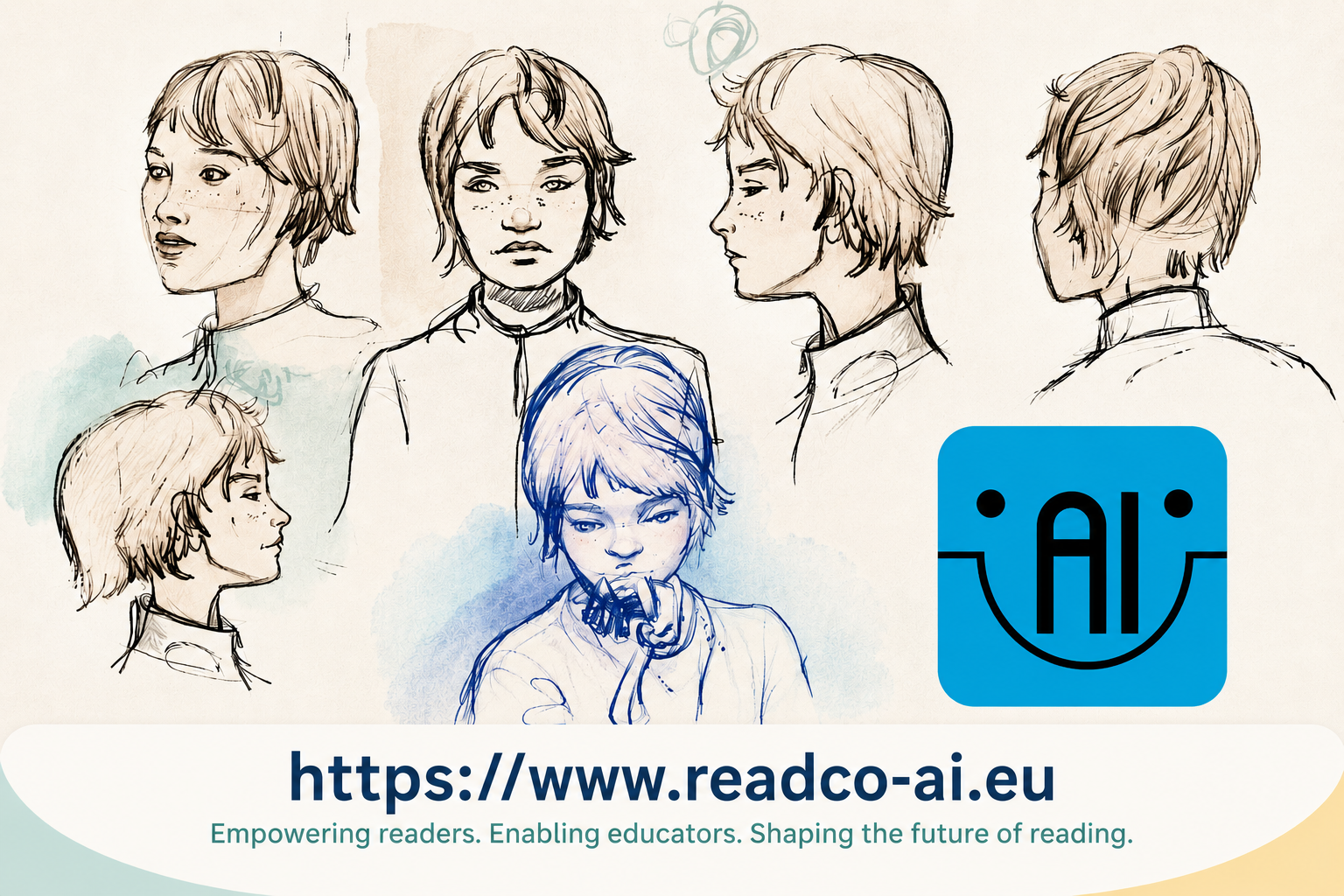
In the current educational landscape, we find ourselves at a critical juncture between two divergent futures. On one hand, we face an “age of digital distraction” where notifications and surface-level skimming have reduced our “cognitive patience” and capacity for deep reflection. On the other, the rapid rise of generative artificial intelligence (GenAI) presents a “performance paradox”: tools that can boost immediate task performance while potentially undermining long-term, durable learning through “intellectual atrophy” and “metacognitive laziness”.
To navigate this complexity, the READCO.ai project—an Erasmus+ strategic partnership—is pioneering a new pedagogy that moves beyond the traditional Human Capital Theory- competencies for the job market. Instead of viewing students primarily as future economic assets, our approach is grounded in the Education for Human Flourishing framework, integrating arts, Socratic AI, and the United Nations’ Sustainable Development Goals (SDGs) to nurture the “whole person” in an increasingly automated world. The plan is to create an app for in-class use and out of class experimentation while training educators, researchers and policy makers to the practical implementation to Human Flourishing conceptual framework (OECD,2025;2026).
The Crisis of Meaning and the AI Paradox
The need for a new pedagogy is driven by a growing “crisis of meaning” in education. International data from The Decline in Volitional Reading report, released in2025 from the National Institute of Education in Singapore, has been published in response to a global downward trend in young people’s engagement with reading, PISA (2019) and PIRLS (2021) indicate that volitional reading (reading for pleasure) is in significant decline as children age and adults. This is not merely a loss of a hobby; recreational reading is longitudinally associated with better mental health, pro-social behaviour, and the “thinking infrastructure” required for academic success.
The emergence of AI exacerbates this crisis if used as an “answer oracle”. When students use GenAI to bypass the “productive struggle” of learning, they risk becoming “digital puppets” who outsource the very cognitive processes—retrieval, analysis, and synthesis—required to build complex knowledge structures in long-term memory. This trend often leads to an “illusion of competence,” where the fluency of AI output masks underlying weaknesses in human understanding.
Education for Human Flourishing: A Conceptual Reorientation Macro-Meso and Micro Levels.
At a macro broad spectrum, the READCO.ai pedagogy responds by adopting the OECD (2025;2026) framework for Human Flourishing (HF), which prioritises “reason-infused”, “emotionally driven” and shared values praxis. This framework is operationalised through five core competencies as a form self-identification through storytelling:
- Adaptive Problem-Solving: The capacity to navigate unstructured and complex global challenges.
- Ethical Competency: Applying moral principles to steer one’s actions and thoughts toward the common good.
- Interpreting the World: Reconciling scientific reasoning with competing worldviews and indigenous wisdom to understand “Where am I?”.
- Appreciating the World: Finding profound meaning in beauty and the sublime—a vital antidote to educational disaffection.
- Acting in the World: Identifying one’s intent and purpose to answer the existential question, “What am I for?”.
By shifting from a knowledge-centric to an anthropo-centric approach, we engage students’ creative and caring capabilities, ensuring they remain the “authors of their own thinking, and artists of empathy and values “.
Visual Narratives: The Power of Comics and Awe
At the meso-scale, READCO.ai utilises visual narratives—comics and animations—to foster engagement and identity validation. Grounded in neuroscience, these media evoke emotional connections through mirror neurons and emotional contagion, enabling readers to simulate empathetic responses to social challenges.
Comics are not merely supplementary; they are transformative tools for inclusive learning. They support Dual Coding (integrating images and text), which improves memory retention and attention, particularly for learners with dyslexia or those facing an “affective filter” in a second language. Furthermore, character-driven stories trigger the release of oxytocin, linking narrative immersion to empathy development (Themelis & Sime, 2019).
A prime example is our story of Amara and the Manta Ray, aligned with UN SDG 14 (Life Below Water). The story follows Amara’s journey from childhood awe to her role as a prolific biologist who creates a global database (Manta Matcher) to protect the reef. This narrative allows students to experience “mature empathy”—the coexistence of peace and worry—while modelling how aesthetic wonder combined with scientific reasoning can lead to purposeful action.
At micro and personal level, AI as a Socratic Partner: The Slower Path
The most innovative aspect of the READCO.ai project is its integration of AI as a Socratic partner rather than a source of ready-made answers. We advocate for a “slow AI” experience, where the technology acts as a “cognitive mirror” in possibility thinking.
Our AI agents are configured to facilitate dialogue using the Socratic method, asking probing “why” and “how” questions that force students to externalise and refine their thinking. For instance, instead of summarizing Amara’s story, the AI might ask: “Would Amara have been as successful if she approached the reef as a purely scientific project, or did the village elders’ legend provide necessary motivation?
Amara stands at the water’s edge. Reflecting on her life’s work, do you think she felt a sense of peace, or a lingering worry that the next generation might not listen as she did?
This approach reclaims “productive friction”—the cognitive struggle essential for building deep comprehension. By positioning the AI as a “cognitive mirror”, that does not judge or answer the questions. We demand that the learners maintain primary cognitive agency and became aware of the thoughts and feelings s when they write about the storytelling.
Bridging the Metacognitive Equity Gap
The READCO.ai pedagogy is also a matter of social justice. Left unstructured, AI use creates a worrying “Matthew Effect“: students with high prior knowledge and strong self-regulation use AI as an amplifier, while novice or disadvantaged learners fall prey to “detrimental offloading” and fall further behind.
To close this metacognitive equity gap, our platform provides metacognitive prompts and scaffolded interactions that are non-optional in the form of multiple-choice questions and individual study packs to enhance vocabulary level B2 in 6 languages (English, French German, Turkish, Bulgarian and Greek). By integrating these supports directly into the learning environment, we help students transition from “extraneous offloading” (e.g., using AI for grammar checks) to “intrinsic engagement” with complex ideas. High reading engagement has been shown to mediate the effects of socioeconomic disadvantage, allowing low-income students and immigrants who are highly engaged readers to outperform high-income students who are not.
Implications for Professional Practice and Policy
The integration of GenAI in the classroom requires a reprofessionalisation of teaching. We must move toward a model of teacher-AI teaming, specifically augmentation through synergy. In this model, teachers and AI work in tandem, critiquing and refining each other’s outputs to achieve instructional quality that neither could perform alone.
To maintain teacher autonomy, we advocate for Human-Centred Design (HCD), positioning educators as co-design partners who control the settings and pedagogical logic of the AI tools they use. AI should scale the expertise of the human teacher—the expert best placed to manage the relational work of motivation, role-modelling, and building trust—rather than replacing them.
Authoring a Future for Flourishing
The challenge of AI in education is fundamentally pedagogical, not technological. Our goal is not to protect students from a world where cognitive offloading is the norm, but to arm them with the deep domain knowledge and analytical capabilities needed to think critically and empathetically with and about AI. The app is developed with these principles and aims to be used as a role model for other creative endeavours.
By combining the emotional resonance of visual storytelling with the intellectual rigor of Socratic AI dialogue, READCO.ai offers a proof of concept for a pedagogy of engagement. In this framework, language learning becomes more than a mechanical skill; it becomes a journey toward human flourishing, where students learn to feel, understand, and act in ways that are authentically human in an increasingly automated world.
As we move forward, the education community must prioritise “slow AI” experiences that protect the “productive friction” of thought. Only then can we ensure that technology serves as a catalyst for awe-struck enchantment and meaningful contribution, enabling every learner to remain the true author of their own thinking that reflect shared values and emotions.
Why it matters
If reading comprehension is ultimately about making meaning in and for the world, then the question we ask learners is not just “What did the text say?” — it is “What does this mean for me and how we live together?” Stay tuned for more inspiring stories, pilot experiences, and exciting updates on the app and the MOOC for educators coming in 2026-27. All resources will be freely available to support teachers and learners worldwide.
About
 Chryssa Themelis, PhD, is an educational innovator and the Director of the Themeli Languages and Research Centre. Her work sits at the intersection of technology-enhanced learning and digital innovation, where she explores how emerging tools can transform educational experiences across borders and cultures. Her latest book, Pedagogy of Tele-Proximity for eLearning: Bridging the Distance with Social Physics, introduces a pioneering framework that redefines how educators and learners connect in online environments. Drawing on the principles of social physics, the book challenges conventional notions of distance in digital learning. It offers practical, research-driven strategies for fostering meaningful human connections in virtual spaces.
References
Beghetto, R. (2026). Developing creativity with generative AI: A conversation with Ronald Beghetto. In OECD (Ed.), OECD Digital Education Outlook 2026: Exploring Effective Uses of Generative AI in Education. OECD Publishing. https://www.cedefop.europa.eu/files/062a7394-en.pdf
Cukurova, M. (2026). A conceptual framework for teacher-AI teaming in education: Harnessing generative AI to enhance teacher agency. In OECD (Ed.), OECD Digital Education Outlook 2026: Exploring Effective Uses of Generative AI in Education. OECD Publishing. https://www.cedefop.europa.eu/files/062a7394-en.pdf
Kharbach, M. (2026). AI-based strategies to enhance reading comprehension. Self-published. https://www.educatorstechnology.com/wp-content/uploads/2026/01/AI-Strategies-to-Boost-Reading-Comprehension.png.webp
Lodge, J. M., & Loble, L. (2026). Artificial intelligence, cognitive offloading and implications for education. University of Technology Sydney.
OECD. (2026). OECD Digital Education Outlook 2026: Exploring Effective Uses of Generative AI in Education. OECD Publishing. https://www.cedefop.europa.eu/files/062a7394-en.pdf
Loh, C. E. et al. (2025) The Decline in Volitional Reading: Evidence-Informed Ways Forward. National Institute of Education, Nanyang Technological University, Singapore. https://cdn.ourfp.org/wp-content/uploads/20250626115546/Loh-C.-E.-et-al.-2025-The-Decline-in-Volitional-Reading-Evidence-Informed-Ways-Forward.pdf
The Open University. (2024). Decline in volitional reading: Evidence informed [Video]. YouTube.
Mullis, I. V. S., von Davier, M., Foy, P., Fishbein, B., Reynolds, K. A., & Wry, E. (2023). PIRLS 2021 international results in reading. Boston College, TIMSS & PIRLS International Study Center.
Themelis, C., & Sime, J. (2019). Comics for inclusive, technology-enhanced language learning. Lancaster University. https://eprints.lancs.ac.uk/id/eprint/140220/1/Sime_Themelis_final.pdf
Topali, P., Ortega-Arranz, A., & Molenaar, I. (2026). Transitioning from general-purpose to educational-oriented generative AI: Maintaining teacher autonomy. In OECD (Ed.), OECD Digital Education Outlook 2026: Exploring Effective Uses of Generative AI in Education. OECD Publishing. https://www.cedefop.europa.eu/files/062a7394-en.pdf
Pooley, J. (2026, May 19). The Matthew Effect in AI Summary. LSE Impact Blog. https://blogs.lse.ac.uk/impactofsocialsciences/2026/05/19/the-matthew-effect-in-ai-summary/
