Core Skills for Today’s Future of Work

Jamillah Knowles & Digit / Building Corp / Licenced by CC-BY 4.0
This article is a guest contribution by John Storm, who comments on the topic of AI from an entrepreneurship and business education perspective. “The topic of AI, its use cases, ethics, role out, impact on the future of work, the scepticism etc is a talking point almost every day within what I do“, John explained. “I find that exposure and perspective towards AI is massively shaped by our localised leadership – whether that be political agenda nationally, the company within which we work, or our social clique“.
Read John Storm’s perspective on how AI is impacting core skills for the future of work.
AI is radically changing the job landscape
Investment in AI has surged in recent years. During 2025, AI related start-ups captured almost 50% of global funding (Teare, 2026). Within the US context, the Mag-7 alone invested a combined value greater than the national budget for the Department of Defense’s Military Programs (Treasury, 2025). As AI technologies rapidly mature and diffuse amongst working populations, the impact of real AI use cases is increasingly being felt all around us. This is leaving many to question what it means for the future of work.
Social media is full of influencers commenting on how AI is bringing life changing efficiencies and benefits to their experience of work. The number of job vacancies requiring AI literacy is doubling year on year (Bloomberg, 2025). And beyond expectations for employees to be using AI tools at work, it is estimated that 1.3 million jobs have been created through AI, via new roles such as AI Engineers, Forward-Deployed Engineers and Data Annotators (LinkedIn, 2026). Perhaps the statement that best encapsulates the radical degree to which our job markets are being changed is in Korn Ferry’s TA Trends report for 2026 that quips “Your next hire might not be human”. Alluding to the rise of agentic AI: bots are now managing teams of bots!
So how do we, as human workers, respond to such a radical shift in the workplace?
Acknowledging that AI is not impacting all sectors equally
For organisations in sectors proactively adopting AI, the average efficiency gains are anticipated to reach 37% by 2026 (Accenture, 2025). Clearly, acquiring proficiency across a range of AI skills is going to be increasingly important.
To foster this understanding of AI and familiarise the masses with the various tools available, NVideo Google, Microsoft and other tech giants are offering training courses to provide free education on Gen AI – whether such courses are to be viewed as support for the better good of society or an attempt to increase user adoption of an entities’ own tools is a separate discussion! Several nation states are also reacting to the changing AI landscape as a matter of national interest. For example, the UK Government just last month launched a series of AI courses aimed at reaching 10 million workers by 2030 – an ambitious goal that equates to around 30% of the country’s working population (BBC, 2026).
However, the distribution of AI utilisation is not equal across sectors and regions. Whereas sectors such as IT, insurance and education have widespread AI adoption, others such as construction and hospitality have noticeably less so (Accenture, 2025). This has led to a clear belief held by over two thirds of American’s that trade work offers a greater level of protection from the disruptive forces of AI (Credit Karma, 2024), with as many as 50% of young adults communicating an intention to transition into such professions (Ibid).
What does all this mean for people at the individual level? Are people expected to upskill or change career? For individuals with uncertainties about how AI is impacting the future of work, despite news headlines and social influencers maybe making one feel behind the curve, such individuals actually form part of an overwhelming majority. Some 80% of employees feel unprepared (Shapero, 2026).
Key skills in a maturing AI workplace
At times of uncertainty, it is important to step back and see the bigger picture. With regards to the future of work, it may be useful to explore reports from some of the worlds’ leading HR and talent acquisition consulting companies. Via surveying with leaders from thousands of multi-nationals, these reports help us to understand what skills HR leaders are desiring in their recruits. And no, recruit does not mean new entrant on to the job market but spans across all ages and levels of experience. To safeguard one’s career, honing such skills may be an appropriate starting point to strengthen one’s career in the AI age.
Human-skills: As AI transforms the transactional elements of our job roles, people skills are increasingly desired by employers
Surveying over 14,400 C-suite executives, HR leaders, employees, Mercer’s Global Talent Trends (2024) report identified 20 HR priorities for 2025. Perhaps counter-intuitively within the world of increasing AI adoption, “improving people managers’ skills” was rated as number 1. People skills typically include items such as authentic communication, fostering relationships, the ability to influence, emotional intelligence, and ability to delegate.
Simplifying one’s professional role into 3 elements may help to understand this increasing emphasis towards people skills and critical skills (Figure 1). (i) Transactional element: routine tasks such as data entry or retrieval, responding to email or enquiries, etc. (ii) Relational element: the servicing, communicating, supervising and/or guiding other people. (iii) Expertise element: the value add that you bring to a role due to your own personal experiences – this may be understanding of how to navigate systems, having the relationships to cut through red tape, or an efficiency in performing particular tasks due to extended periods of iteration and practice.
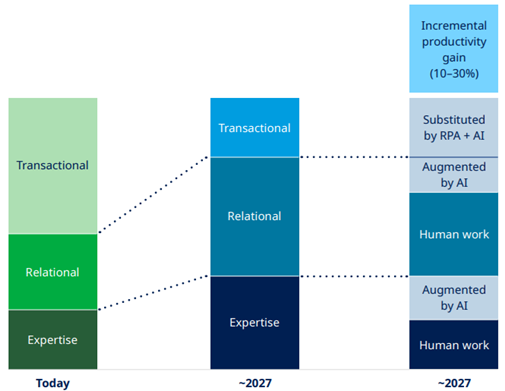
Figure: How Generative AI is Augmenting Jobs. Sourced from Mercer (2024) p.7
AI may augment [occasionally even substitute] a human employee for the transactional aspects of one’s job role. However, the byproduct of this is an increased onus on the remaining two elements of one’s role – the relational element of human work taking precedence.
As one rises in the hierarchical ladder, this becomes even more noticeable. For example, picture yourself as team lead driving the adoption of a new AI tool in your workplace. You have secured funding. The resources are available. The tool is designed and developed. Now what do you need? Adoption. Yet most critically, adoption by users, AKA: people. This improvement of engagement, adoption and utilisation is the realm of change management, a discipline characterised by people.
Critical skills: Boosting personal productivity and resilience, whilst giving the brain a healthy workout for mental wellbeing
“Think First, ChatGPT Second”. So begins the second core trend for 2026 according to Korn Ferry (2025).
Amidst today’s proliferation of certificated courses to demonstrate one’s AI proficiency, 73% of talent leaders are ranking critical thinking and problem-solving skills as the most desirable skill when hiring. AI and related tech skills come in 5th.
Consider the scenario below:
Your company has developed a new dashboard that provides updates on 20 indicators. It pulls live data from appropriate points across relevant functions – developers have done an incredible job to avoid data siloes. Though the development, data gathering and visualisation of the dashboard may have been flawless, we routinely encounter two –potentially all too familiar – challenges:
Challenge 1 – sub optimal inputs: if the selected indicators are sub-optimal, the entire view of the department or business unit may be skewed, thus negatively impacting the quality of decision making.
Challenge 2 – poor interpretation of outputs: receiving accurate information does not equate to correctly interpreting and acting on the data in a timely manner.
Irrespective of AI efficiencies, critical thinking skills are essential to produce optimal outcome. This was recently echoed by Professor Pepinsky (2026) who remarked that the frontier of AI is the intersection of information retrieval and interpretation. And though the example scenario’s may be written in a highly simplistic and obvious manner, when redesigning workflows is one of the main plans for organisations embracing AI (McKinsey, 2025a), getting the designing of new workflows right is of critical importance.
Moreover, and irrespective of our age or profession, honing one’s critical thinking skills is an investment into one’s own “brain capital” by boosting resilience, productivity and growth at the individual level. This is because personal attention span, mental wellbeing, and neurological health are all impacted by how we maintain the health of our brain (McKinsey, 2026). Consequently, viewing work over one’s future lifetime; developing one’s critical thinking skills not only supports sustained competitiveness in the talent market, but offers several health-related benefits too.
Summary Discussion
In today’s volatile, uncertain, complex and ambiguous (VUCA) world, the need for improving people skills and critical thinking skills is intertwined. The literature base in managerial sciences have long recognised that VUCA environments require organisations to increase onus on the people and cultural component of their entity (Hamel and Prahalad, 1983). Systems can become outdated. Automation may exacerbate data siloes and accountability sinks. Structures may be too slow in their response, or unable to cope with competing demands. Yet, provided that an organisations’ culture enables such behaviour, people may critique the status quo and be the needed catalyst for change.
The explosive growth and rapid evolution of AI can otherwise cause widespread confusion – even within firms that are at the forefront of AI. Just last week I joined a well-known Fortune 500 company’s internal meeting that was themed on AI adoption. Over 700 employees from across Europe joined the call to hear about various tools for improving their work. Yet one of the [my] realisations was that many of those on the call did not even realise that they had not registered for the correct license(s) on their work devices.
At the other end of the organisational hierarchy, Korn Ferry (2025) state, “It’s not just about technical literacy. The bigger challenge is communicating authentically about changes that even leaders don’t fully understand.”
The importance of human skills and critical thinking skills is not limited to finding work, staying in work, or getting promoted at work, but is transferable across work disciplines. For example, despite 50 percent of Chief Marketing Officers ranking Gen AI-enabled marketing as a top three fastest growing area of investment, Gen AI and agentic AI was ranked just 17 out of 21 in terms of areas of urgency (McKinsey, 2025b). Themes related to clear, concise and trust building communications dominate 4 out of the top 5 priorities for brands (ibid). Themes that relate back to human skills and critical thinking skills.
As human workers in a world that is embracing a constantly maturing plethora of AI tools, it is important to balance our attitudes towards how AI may impact our careers. Yes, AI proficiency is importance. Yet, in the dash to upskill, don’t forget the importance of other transferable skills – particular human skills and critical thinking skills. At the same time, for those feeling left behind by the AI era, it may be that the key skills needed for success have already been refined through years of past work experience but just need finetuned to complement your future at work.
References
Accenture. (2025) Accenture Strategy Macro Foresight Brief 2026 Outlook
BBC. (2026) Government offers UK adults free AI training for work – BBC News
Bloomberg. (2025) Former UK PM Rishi Sunak on Winning the AI Race – YouTube
Credit Karma. (2024) Gen Z drives a resurgence in blue-collar work – Intuit Credit Karma
Hamel, G., & Prahalad, C. (1983) Managing Strategic Responsibility in the MNC. In: Strategic Management Journal, Vol. 4, No. 4, pp. 341-351.
Korn Ferry. (2025) TA Trends 2026: Human–AI Power Couple | Full Report
LinkedIn. (2026) linkedIn-labor-market-report-building-a-future-of-work-that-works-jan-2026.pdf
Mercer (2024) Workforce 2.0: Unlocking human potential in a machine -augmented world
McKinsey. (2025a) The State of AI: Global Survey 2025 | McKinsey
McKinsey. (2025b) Past forward: The modern rethinking of marketing’s core | McKinsey
McKinsey. (2026) Investing in brain capital: Five levers for change | McKinsey
Pepinsky. (2026) Agentic AI and Social Science Research Practice
Shapero. (2026) AI has already added 1.3 million jobs, LinkedIn data says | World Economic Forum
Teare, G. (2026) Global Venture Funding In 2025 Surged As Startup Deals And Valuations Set All-Time Records
Treasury. (2025) Federal Spending | U.S. Treasury Fiscal Data
About the Author
 John is a second career academic and Director of MBA Programmes at the University of Aberdeen in Scotland. He brings 15 years of experience in strategic planning, leadership development and change management within the Asia Pacific context. Merging the academic and corporate worlds together, John brings his exposure to clientele from diverse cultural and industrial backgrounds back into his teaching. Regularly engaging in executive education and external initiatives, John partners with a range of universities and organisations around the world to generate a myriad of external engagements that synergise with his academic responsibilities.
